Having trouble reading this newsletter?
View our Web version in your browser.



In this issue: |
Description Key | Captioning Key | COAT |
skip to quick hits
The Description Key: New Guidelines for Educational Description!Back to article listing
The Described and Captioned Media Program has partnered with the American Foundation for the Blind to forge a new “key” to equal access for students with vision loss: the Description Key for Educational Media. What is description? Also known as “audio description,” “video description,” and “DVS®,” description is the verbal depiction of key visual elements in media and live productions—components of the production that may be partially to completely inaccessible to students who are blind, visually impaired, or deaf-blind. (Read DCMP’s article “During the Quiet Parts” [PDF] or watch our training production, “Equal Access in the Classroom,” for more information about why description is vital to education.) While description of plays, television programs, and movies started around twenty years ago [PDF], the Key is the first set of guidelines focused specifically on describing educational media. The Description Key is intended for new and experienced describers and description agencies, media producers and distributors, and others who want to make a key contribution to accessible educational media. The Key is separated into convenient sections, such as how to prepare description, how to describe visual information, and what visual information to describe. Visit dcmp.org/KeystoAccess to learn more about the Key, and be sure to check out the DCMP Web site for your free-loan educational accessible media needs. The Captioning Key: Revised Guidelines for Educational Captioning!Back to article listing
The DCMP is also pleased to announce the availability of the revised Captioning Key for Educational Media, now in its fourteenth year! Completely redesigned for the Web, the Key now includes video clips to support the guidelines and is more accessible than ever to readers with disabilities. The Captioning Key has been widely read and distributed (even internationally) since its initial publication in 1994. (Read more about the history of captioning and the Captioning Key in DCMP’s “Captioning Time Line Highlights” [PDF].) It is gratifying to confirm that the Key—and our work with various captioning agencies [PDF]—has a huge positive impact on educational, television, and home-video captioning. Continual feedback from captioning agencies, teachers, and other consumers has also been invaluable in subsequent revisions of the guidelines. The following are testimonials from people regarding their experiences with the Captioning Key: “The Captioning Key for Educational Media is an essential resource for us, and it’s a primary reason why we feel that we offer some of the most readable American English captioning available in the United States today. I don’t know what we would have done without it!” “We always include a copy of the Captioning Key with each Computer Prompting Corporation (CPC) captioning software package we sell. We encourage our clients to use it, as the guidelines in the Captioning Key provide invaluable assistance for those learning to caption.” “My bible! I am a ‘self-taught’ captionist, and I found the Captioning Key about six months into the process of learning how to caption. You would have thought I found gold! Since I began eight years ago, I have captioned over 300 videos. These have been for students from first grade through twelfth grade, all attending schools in the same school district my two deaf children attend.” Visit dcmp.org/KeystoAccess to learn more about the Key. Got your COAT On?Back to article listingThe Coalition of Organizations for Accessible Technology (COAT) was co-founded by the National Association of the Deaf and the American Foundation for the Blind in March 2007. COAT now has over 200 national, state, and community-based organizations as affiliate members. COAT advocates for legislative and regulatory safeguards that will ensure full access by people with disabilities to evolving high speed broadband, wireless, and other Internet Protocol (IP) technologies. COAT wants to ensure that, for example, closed captions can be received and displayed on any video device, television programs distributed on the Internet have closed captions, and description is provided for video programming distributed on television and the Internet. In 2008 comprehensive legislation called the “Twenty-First Century Communications and Video Accessibility Act” (H.R. 6320) was introduced in the U.S. House of Representatives. COAT is actively seeking introduction of similar legislation in the U.S. Senate. The goal of this legislation is to establish new safeguards to ensure that people with disabilities are not left behind as technology changes and the United States migrates to the next generation of Internet-based and digital communication technologies. What can you do? Learn more about COAT. Visit www.COATaccess.org. Encourage your state- and community-advocacy organizations to become affiliate members of COAT, so you can stay informed about COAT activities. Grassroots advocacy action will be needed to get this legislation passed. Learn more, and be ready to put your COAT on and take action. |

DCMP Featured in FCTD NewsletterBe sure to read the September issue of The Family Center on Technology and Disability newsletter (also available as a PDF document), which is titled “Caption This: Television Captioning and Description in the Digital Age.” The feature article is an interview of DCMP administrative staff. 
Vote Equal Access in ’08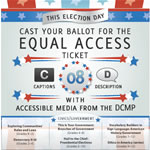
Tuesday, November 4th is Election Day across the U.S.! Our new Election Day flyer [PDF—pictured above] includes a list of some of our titles related to civics and government. Since 2008 is a Presidential election year, many students are already aware of the high stakes that accompany our electoral process, even if they don’t fully understand it. Why not demystify the process with a special election-themed lesson or family-night discussion, complete with one of our accessible educational titles? While you’re at it, check out Kids Voting USA for more ideas on getting students of all ages interested in the electoral process!
|

|
The Described and Captioned Media Program is funded by the U.S. Department of Education and administered by the National Association of the Deaf. Opinions expressed in the DCMP Newsletter do not necessarily reflect those of the U.S. Department of Education or Offices within it. |
Visit the DCMP Web Site |
This newsletter is distributed to DCMP clients and other interested persons.
If you received this newsletter as an e-mail forward or found it on the Web, and you would like to sign up to receive the semi-monthly DCMP newsletter, please visit our sign-up page on DCMP.org.