<< Learning Center
Media Accessibility Information, Guidelines and Research
Finding Deaf Herstory and History: Resources for the Classroom
By Harry Lang
A few years ago, the great-great-granddaughter of the Deaf pioneer and National Association of the Deaf (NAD) supporter, Edmund Booth, told me a story about her great-niece learning about the California Gold Rush in her social studies class. The young girl excitedly shared the fact that she was a descendant of a "Forty-Niner," but her classmates and her teacher did not believe her. She called her dad and asked him to bring the book Edmund Booth, Deaf Pioneer when he picked her up that day. During a subsequent "show-and-tell" activity, she was thrilled to use the book to explain about her proud heritage that included Edmund Booth and his wife Mary Ann Walworth Booth, both Deaf.
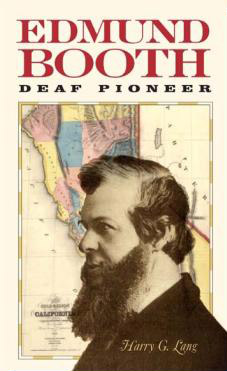
Gallaudet University Press, 2004
This story about the young descendant of the Booths reinforces the motivation behind much of my book writing. Deaf people were involved in many important events throughout history, and these stories need to be told, not only to children, both hearing and deaf, but also to their teachers and parents.
Deaf and hard of hearing people contributed in meaningful ways throughout history—as artists, writers, scientists, community leaders, and in many other roles. But Deaf women who were actively involved in both the Deaf and hearing political and social worlds have remained highly invisible. One was Laura Redden Searing, the Deaf poet and Civil War journalist who came to my attention while I was working with Bonnie Meath-Lang in the 1990s on the book Deaf Persons in the Arts and Sciences: A Biographical Dictionary.
More recently, while conducting research for my book Fighting in the Shadows: Untold Stories of Deaf People in the Civil War, I was delighted to come across a treasure trove of Laura Redden's personal papers, including letters, diaries, scrapbooks, and heretofore-unknown photographs. They are certainly enriching our understanding of this extraordinary Deaf woman's accomplishments during the Civil War. Redden's work is described in detail in this book.
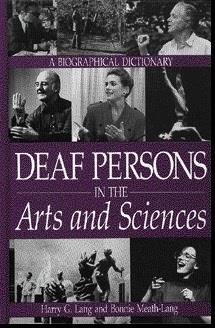
Greenwood Press, 1995
In another book, edited by Judy Yaeger Jones and Jane E. Vallier in 2003, titled Sweet Bells Jangled: Laura Redden Searing, A Deaf Poet Restored, a short biography of Redden is included. It is well worth reading and sharing with others.
After entering the Missouri School for the Deaf, Redden began to publish verse and prose at the age of 17. After graduating in 1858, she began her lifelong career as a writer at the age of 19 in the midst of pre-Civil War chaos and escalating violence in St. Louis. Assuming the pen name "Howard Glyndon" as her career in journalism developed, she wrote hundreds of poems and newspaper articles. By 1864, she had formed friendships with General Ulysses S. Grant and President Abraham Lincoln. John Wilkes Booth learned some sign language from her while she helped him write a love sonnet for his fiancée. Her friendship with the Lincoln family had developed when she visited the White House during the Civil War. Lincoln's assassination affected her deeply. She considered both President Lincoln and John Wilkes Booth her friends. Redden later felt that Ford's Theatre should be razed and a monument "erected to mark the spot where Lincoln's blood was shed." The cause for which many people like Laura Redden had argued so passionately had been won at a terrible cost.
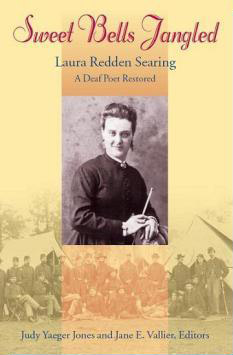
Gallaudet University Press, 2003
Throughout history there were many women like Laura Redden whose lives were intertwined with great historical events as they overcame the communication and attitudes associated with deafness. In the 1920s, Tilly Edinger, the German-American fossil expert, established the field of paleoneurology, the study of fossil brains. She narrowly escaped the Nazis during the Holocaust. Her hearing brother had been killed in a concentration camp. Edinger published more than 400 papers about fossils. Ruth Benedict, because of her deafness, pursued visual aspects of cultures (architecture, painting, etc.), thus expanding the field of anthropology, which had previously focused mostly on folklore, a difficult area for a Deaf person to study. Another deaf woman, Laura C. Sheridan, presented a passionate plea for higher education for Deaf women in 1875. Such advocacy by Sheridan and other Deaf women opened both doors and minds. In time, with these new opportunities, many Deaf women would contribute to astronomy, medicine, performing and visual arts, literature, and other fields.
Importantly, these stories about Deaf women and men are becoming increasingly available to teachers and students. As Deaf and hearing scholars develop an expanding resource library of Deaf studies books and articles, and as excellent films captioned for the classroom to provide a broader historical context become available, teachers and students now have rich resources.
One valuable resource for media to enhance learning about the roles of Deaf women and men in history is the Described and Captioned Media Program (DCMP). DCMP offers free-loan described and captioned educational media in all subjects, including historical footage of key figures and events in Deaf history.
When viewing the offerings on the DCMP website, I found numerous titles related to women of the West and homesteading on the Great Plains—very good titles to bridge to the book Edmund Booth, Deaf Pioneer. Edmund had built the first frame house in Anamosa, Iowa. There was no white settlement five miles west of their new homestead. One marvels to imagine this Deaf couple living without fear on the Plains among wildcats and rattlesnakes in often unpredictable weather. His remarkable Deaf wife, Mary Ann Walworth Booth, raised a family for five years, alone, while he was in California during the Gold Rush.
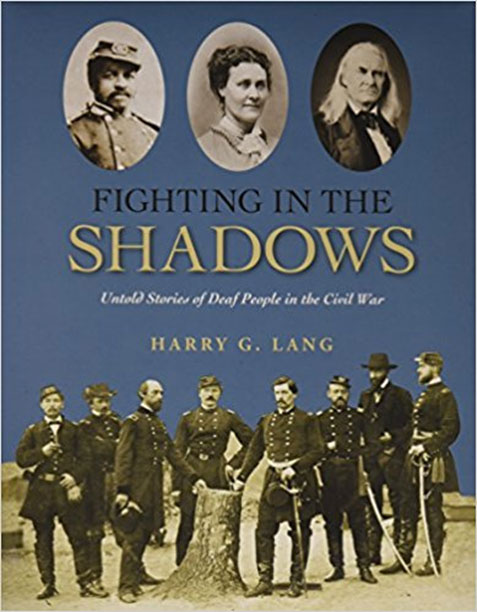
Gallaudet University Press, 2017
As another example, I found DCMP Civil War documentaries related to Lincoln, the Battle of Gettysburg, and causes of the Civil War—great titles to learn the broader context of Laura Redden's work and that of other Deaf women and men during the War of the Rebellion. DCMP is a wonderful resource for teachers!
Watching a captioned DVD about Lincoln made me think about how the President of the United States, with the war still going on, took the time to read one of several books of verse written by Laura Redden. On the cover of the manuscript of her volume published in 1864, titled Idyls of Battle and Poems of the Rebellion, Abraham Lincoln personally wrote a note to Redden. He had found the poems "all patriotic and some of them very pretty." The DCMP title, Battle of Gettysburg, made me think once again about Redden's poem, "The Graves of Gettysburg" published in this book. I imagined the young Deaf poet writing by candlelight the final stanza about the brave soldiers who had died on the Gettysburg battlefield in July 1863:
Let us lay them where they fell,
When their work was done so well!
In the martyr's noble silence,
Leaving us the tale to tell."
There are many other stories about Deaf women and men writers, nurses, soldiers, and spies, and how they fought for causes in which they believed. Combining books and articles from Deaf Studies and the use of the media and documents at DCMP is a great way to present Deaf Herstory and History at its best. The approach emphasizes that Deaf people were very much a part of mainstream events in our past.
Harry Lang, Professor Emeritus, is now retired from the National Technical Institute for the Deaf (NTID) at Rochester Institute of Technology (RIT), where he taught for more than 40 years. He has authored ten books in the area of Deaf Studies. At RIT he was honored with the Eisenhart Award for Outstanding Teaching. In 2013, Gallaudet University presented him with an honorary doctoral degree. Two of his books, Edmund Booth, Deaf Pioneer, and Moments of Truth, Robert R. Davila, the Story of a Deaf Leader (with Joseph Fischgrund and Oscar Cohen) were chosen for "Deaf America Reads" by the National Literary Society of the Deaf.
DCMP Accessible Media: A Sampling of Titles About Deaf Men and Women In Mainstream History
- Celebration Of Deaf Dance
- Deaf Mosiac (21 episodes from the Emmy–winning series)
- Deaf TV: Role Models
- Famous Deaf Americans - Part I
- Famous Deaf Americans – Part II
- Laurent Clerc (1785-1869)
- See What I'm Saying: The Deaf Entertainers Documentary
Tags:
Please take a moment to rate this Learning Center resource by answering three short questions.